
For Leasing Directors, Heads of Leasing and Asset Managers
You’ve negotiated million-euro deals before. So what’s different this time?
But this commercial lease isn’t moving as expected.
You know the numbers.
You know your leverage.
You have an explanation for what’s happening.
But does what you’re seeing actually fit that explanation?
DealLens helps you challenge your reading of one live commercial real-estate negotiation before deciding your next move.
One shape this takes
- Round 01
Heads of terms agreed in the room
- Round 02
Revised draft sent
- Round 03
A settled point reopened
- Round 04
Eleven days of silence
- Next round
Your move needs to be decided before it
An illustration, not a client case. Your sequence is your own.
You probably have an explanation
The explanation you may be using
- They want a lower rent.
- More flexibility.
- Better terms.
- More time.
And you may be right.
But something does not fit
- They ask for a concession. You make it. Nothing moves.
- A point you thought was settled comes back.
- The meeting goes well. Then silence.
None of these tells you why. But something in your explanation no longer fits.
The dangerous moment in a high-value negotiation is not always when you have no explanation. It is when you start making decisions based on an explanation you have stopped questioning.
That is where DealLens starts.
I won’t tell you what the other side is thinking. I’ll help you see what you don’t know yet.
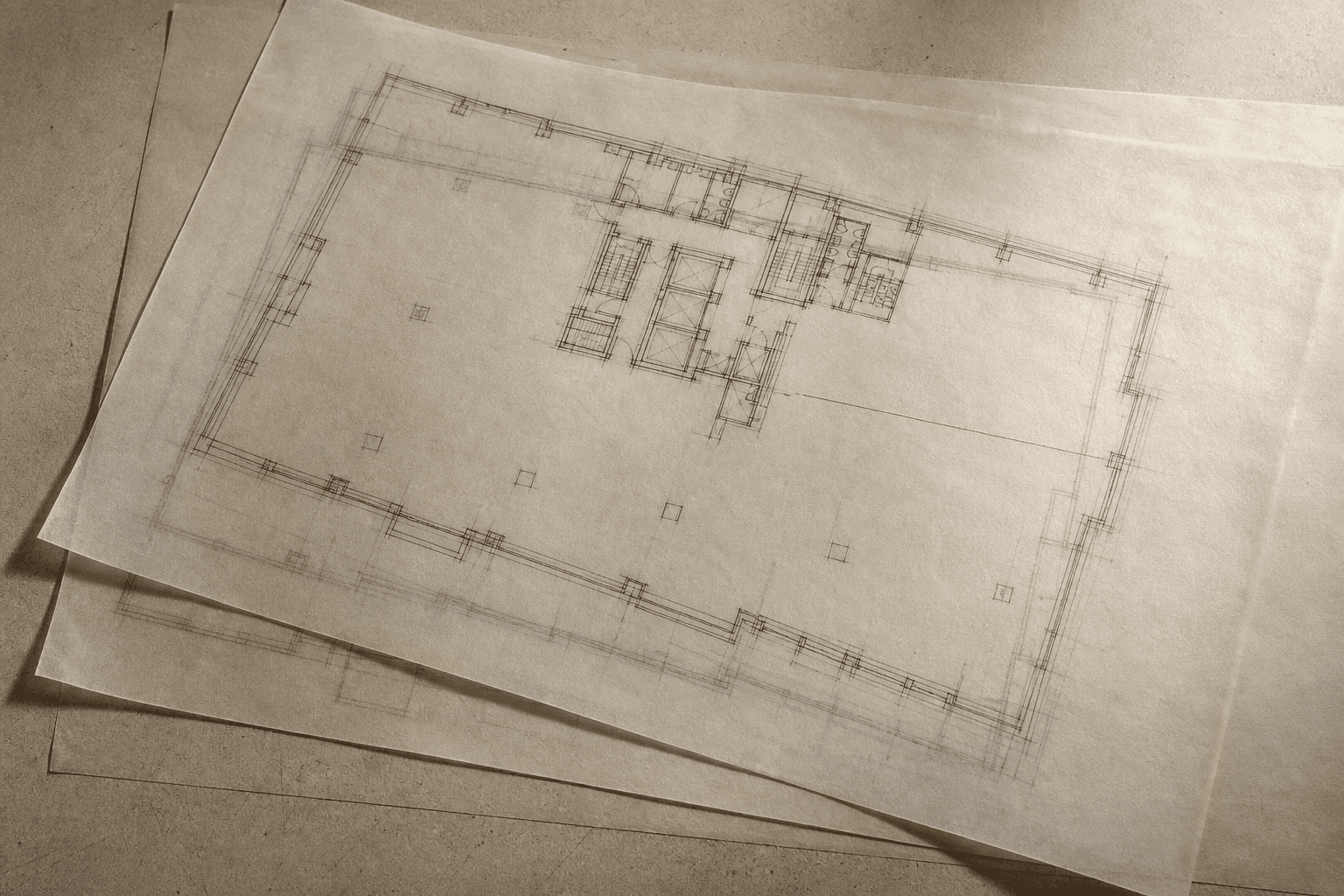
The same floor plate, drawn three times. The lines only look identical until you lay them over each other.
Exhibit
What you know, and what you may be assuming
Two columns, in your own sentences. On the left is what you observed. On the right is what you concluded from it, and have been treating as settled.
Observed
Interpretation you may be treating as fact
ObservedThey have not replied to the revised heads of terms for 11 days.
AssumedThey are using silence as pressure.
ObservedTheir director said yes to the break clause on the call.
AssumedThe break clause is settled.
ObservedThey asked for the service charge cap a second time.
AssumedThey reopened it to bring the rent down.
ObservedA new name was copied into the last email from their agent.
AssumedThe new name is a formality.
Every line on the right may turn out to be true. None of them is observed yet. The work is to see which of your own sentences sits on which side, then to ask what would tell the two apart before you commit to a move.
These are hypotheses drawn from your answers, not conclusions about anyone. DealLens does not claim to know why a person behaves as they do, and says plainly when something is unknown.
The sequence, in order
- 01
Establish what actually happened.
- 02
Separate observed facts from interpretation.
- 03
Identify the signals and changes that matter.
- 04
Generate several possible explanations.
- 05
Identify the information that is missing.
- 06
Decide what to observe, ask or test.
- 07
Only then decide what should change.
Where useful, DealLens explores possible decision drivers such as perceived value, trust, status, uncertainty, risk or motivation. They are hypotheses to test, never conclusions about what is happening inside someone else’s head.
This is not a reading of anyone’s character. It is a discipline applied to one situation.
A different lens on the decision
DealLens applies Brain Modus Operandi, a neuroscience-based meta-model developed to identify the triggers behind commitment and resistance.
What people say they want and what ultimately moves a decision are not always the same thing.
Price, terms and timing are visible.
Underneath them may sit tensions around value, risk, trust, status, uncertainty, control or motivation.
DealLens does not claim to know which one is driving the person across the table.
It gives us a map of what to look for, what to question and what to test.
One live negotiation. One critical round. Two sessions.
Before the round
Preparation session
- Challenge the current reading of the negotiation.
- Separate what is known from what is assumed.
- Identify what may still be missing.
- Decide what to explore before or during the next interaction.
Output
Either a clearer Next Move, or an Information Map.
After the round
Debrief session
- Examine what actually happened.
- What changed.
- What new information appeared.
- What it changes about the next move.
500 €
Once
Millions may be at stake.
A second look costs 500 €.
The expensive decision may be the one you make based on an assumption you never tested.
The guarantee
You leave the preparation session either with a clearer strategy for the next round, or with a clear map of the information you need before deciding your next move. If neither happens, the 500 € is refunded in full.
DealLens never guarantees winning the negotiation, closing the deal, obtaining a specific concession, saving money, or any financial result. The guarantee is about clarity and only about clarity.
- Price
- 500 €
- Refund
- In full, on request
- Language
- English
- Capacity
- Two intervention slots available each week
- Confidential
- Mutual NDA on request
Who does the work
Stéphane Demicheli
Co-Founder of Brain Modus Operandi
My expertise is the neuroscience of decision.
I focus on one thing: what happens in the brain when someone says yes or no.
With DealLens, I apply that lens to one live commercial real-estate negotiation at a time.
Brain Modus Operandi is a protected meta-model built from 20 years of applied work in neuroscience. DealLens is a new and deliberately specialised application of it to high-value commercial lease negotiations. The method has a history. This application of it is young, and Stéphane delivers every session personally: two intervention slots available each week.
What you say stays between the two of you. Nothing is published or reused without your written consent.
The 15-minute call does not require an NDA. We only need enough context to understand whether DealLens is relevant to your situation. If we decide to work together, a mutual NDA can be signed before confidential negotiation material is shared.
What this is not
- Not negotiation training.
- Not legal advice.
- Not psychological profiling.
- Not a promise about the outcome.
What DealLens takes today
In scope
- New commercial leases
- Lease renewals
- Lease renegotiations
- Rent reviews
Live, several rounds in, with an important interaction coming inside the next few weeks.
Not in scope
- Acquisitions and disposals
- Legal position and contractual risk, which your lawyer answers
- Market comparables and valuation
- Negotiation skills programmes and workshops
- Residential transactions
If your situation sits here, you will be told at the first step, with a note on what would actually help.
Start with seven questions about your negotiation
The Deal Read reflects back what you know, what you may be assuming, what does not yet fit, and what may be worth exploring before your next move. It is free, it takes a few minutes, and it makes no claim about the other side.
If the next round is close and the deal is large, take the confidential call instead. 15 minutes with Stéphane, free, and the 500 € Intervention is only offered afterwards if the situation fits.
No account and no payment on either path. Payment for the 500 € Intervention happens only after the call, and only if the situation fits.
Two intervention slots available each week.
Delivered personally, so the number is a capacity and not a device.
Next call availableThursday 3 September, 10:00 Bucharest